
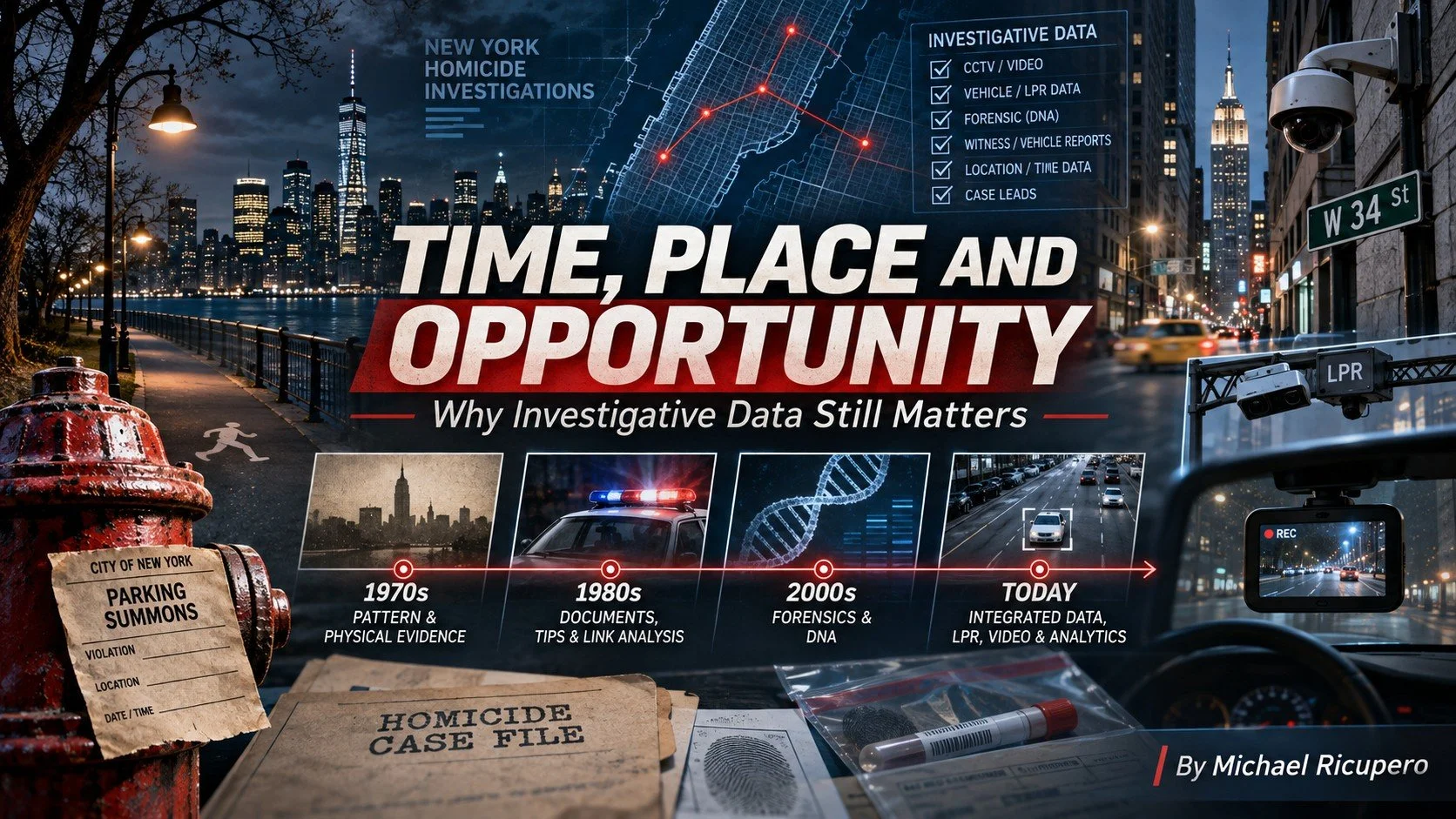
Time, Place and Opportunity
By Michael Ricupero — Retired NYPD Lieutenant Detective Commander | Former Commanding Officer, Real Time Crime Center
Over the past couple of months, I've watched the debate over police technology get louder. License plate readers, surveillance cameras, data retention—you name it. Some of the questions being raised are fair. We should always be able to explain why a tool is being used, what it can actually do and what safeguards are in place.
But I've also seen people, including some in our own law enforcement technology space, suggest that police departments are using murders and other violent crimes as scare tactics to justify keeping certain technologies. That's where I have a problem.
Not because technology should be above criticism. It shouldn't. But if we're going to have this conversation, let's have it based on facts and actual investigative work.
On October 30, 2026, Katie Suarez, a 28-year-old woman, was stabbed while jogging along the Shore Parkway Greenway in Brooklyn. Her father went looking for her when she didn't arrive as expected and found her critically wounded. She died a few days later.
When I read about the attack, I immediately thought of Karina Vetrano, who was murdered while jogging in Howard Beach, Queens, in 2016. Her father also went searching for her when she failed to come home. The circumstances are hauntingly similar: two women out for a run, two relatively isolated locations and two families whose lives were changed forever.
NYPD Chief of Detectives Joseph Kenny made that comparison publicly, too. Chief Kenny was my boss at the NYPD, and I can tell you firsthand that he's as sharp as they come. He worked the Vetrano investigation and said he went back and reviewed that case to see whether anything might help detectives now. When someone with his experience does that, I pay attention. It doesn't mean the murders are connected. It means you don't overlook a lesson from an earlier investigation.
To me, these cases bring us back to three basic investigative principles: time, place and opportunity. Where was the victim? Who else was there? What could someone have seen before or after the attack? And what information is available to help detectives answer those questions?
Here's an important detail in the Suarez investigation. Chief Kenny said there was no camera coverage at the immediate scene, but a license plate reader on the nearby Belt Parkway recorded roughly 1,700 passing vehicles during the period investigators were looking at. Detectives want to reach those drivers because one of them may have dashcam footage that helps piece together what happened.
Those aren't 1,700 suspects. They're potential witnesses. Someone may have recorded a person, a vehicle or a movement that meant nothing at the time but could mean everything to this investigation. We don't know yet whether that footage exists or whether it will provide a break. But tell me that isn't a legitimate reason to examine the data.
And this is nothing new. We've been connecting pieces of information to solve crimes long before anyone was talking about artificial intelligence or automated license plate readers.
Go back to 1977 and the Son of Sam investigation. A woman who had been walking her dog remembered a suspicious man and a car being ticketed near a fire hydrant around the time of the final shooting. Detectives traced the parking summons. At the same time, Yonkers police had information from a separate complaint involving David Berkowitz. Those two leads came together and helped bring an extraordinary manhunt to an end.
A parking ticket. Think about that. It wasn't the ticket alone that solved the case. It was a witness, a record, another police agency and investigators who knew how to connect the dots.
Now look at the Vetrano case. Investigators recovered important DNA evidence, but for months they didn't have an identification. The break came when NYPD Lieutenant John Russo recalled an earlier encounter involving Chanel Lewis. Police went back to prior reports and summons records, located Lewis and obtained a DNA sample that matched evidence from the crime scene. He was eventually convicted of Karina's murder.
Again, the data didn't solve the case by itself. A police officer remembered something, detectives followed through, and forensic evidence helped establish the connection. That's what good investigative work looks like.
Then there's the December 2024 murder of UnitedHealthcare CEO Brian Thompson in Midtown Manhattan. This was a very different crime—a targeted attack in a heavily monitored part of New York City. If you're going to commit a high-profile murder in Midtown, you should understand that you're moving through an area with cameras all over the place.
Surveillance footage helped detectives reconstruct the suspect's movements before and after the shooting. Images were released to the public, and Luigi Mangione was recognized and arrested in Pennsylvania days later. Investigators also recovered physical evidence. The cameras didn't prevent the murder, but the information they captured became an important part of the investigation.
Now compare that with a dark stretch of the Brooklyn waterfront where Katie Suarez was attacked. There isn't the same camera coverage. That's a major difference, and it's why something as simple as a passing driver's dashcam may matter so much.
Four investigations, nearly 50 years apart. Very different circumstances, but the same underlying principle: time, place, opportunity and the ability to connect information.
I spent more than 20 years with the NYPD, including my final three as Commanding Officer of the Real Time Crime Center. I saw firsthand what happens when detectives have the right information at the right time. I also saw the other side of it—when important information exists but isn't readily available, and investigators spend valuable time trying to track it down.
Let's be clear about something else. Information isn't useful only when it points to a suspect. Sometimes it eliminates somebody. Sometimes a video, a location record or a witness statement tells detectives their original theory was wrong. That's just as important. A lead is a lead until it is independently corroborated. Technology doesn't change that standard.
So when I hear these blanket accusations about scare tactics, I have to ask: are we really evaluating the technology and how it's used, or are we reacting to the controversy surrounding it?
There are legitimate concerns about privacy, misuse, retention and oversight. I've never believed police technology should be a free-for-all. Departments should have clear policies, controlled access, audits and accountability. The public deserves to know how these systems are used. And no, pointing to one terrible crime does not automatically justify every tool or every retention period.
But there's also a difference between exploiting a tragedy and explaining a real investigative need. A police department should be able to say, 'Here is what this technology provided in an actual investigation,' without automatically being accused of fearmongering. If you disagree with the tool, show me the data, the policies, the results and the tradeoffs. That's a conversation worth having.
I hope the information being gathered in Katie Suarez's case gives detectives the break they need. I can't tell you that a license plate reader or a dashcam will solve her murder. Nobody can. What I can say is that investigators deserve every lawful, properly governed lead they can develop—and the family deserves answers.
In 1977, a parking summons helped point police toward the Son of Sam. In 2016, an earlier police encounter and DNA evidence helped solve Karina Vetrano's murder. In 2024, cameras helped reconstruct the movements of the man responsible for killing Brian Thompson. Now detectives are looking at license plate data and potential witnesses in the murder of Katie Suarez.
Technology will never replace good police work. But good police work has always depended on information, and sometimes the smallest piece of information is the one that breaks a case wide open.